

Hunger and fullness are not two switches
We tend to think of hunger and fullness as opposite states: either I am hungry, or I am full. In real experience it is almost always different. Between the moment you sit down and the moment you stand up there is a gradual passage, made of small changes that you notice only if your attention is in the room.
People who study eating behaviour distinguish two phenomena. Benelam, in a 2009 review, describes satiation as the set of processes that bring a meal to an end, and satiety as the state that follows, making it less likely that you start eating again in the following hours. Two different things, on different timescales. In everyday speech we use one word, and that flattens an experience that actually has a duration.
I would add a third element, the one least often discussed: satisfaction. You can finish a meal with a full stomach and no satisfaction at all, or leave the table content with a smaller portion than you had pictured. If you read the article on physical and emotional hunger, this is the same story seen from the other end of the meal.
Fullness and satisfaction are not interchangeable
Fullness has an obvious physical side: volume in the stomach, a slowing down, the sense that the food is enough. Amin and Mercer, in a 2016 review, point out that gut, hormonal and nervous signals all take part in regulating hunger and fullness, and that the picture is complex. Satisfaction, on the other hand, has to do with taste, temperature, texture, context, and the meaning that food carries for you.
In practice this distinction changes a great deal. Someone tells me she has salad and chicken breast for dinner, feels full, and two hours later is in the kitchen looking for something. It was not the amount that was missing. It was the flavour, or the temperature, or the pleasure. The body keeps asking for what it did not receive, and the evening gets long.
Among the principles of Intuitive Eating described by Tribole and Resch there is precisely an invitation to take the pleasure of eating into account, not only fullness. This is not a decorative detail: it shapes how a meal comes to an end.
Taste changes while you eat
One well documented phenomenon explains a lot. Rolls, in a 1986 paper, described sensory specific satiety: while we eat a food, the pleasure it gives tends to decline, while it stays intact for foods we have not eaten. That is why there is always room for dessert after a generous first course.
At the table this becomes very concrete. The first mouthful of a dish you like has an intensity the fifth one no longer has. If attention is elsewhere, that decline goes unnoticed and you keep eating in search of the intensity of the beginning, which does not return. If you do notice it, the decision to continue or to stop comes from the taste rather than from a rule.
- The taste of the first mouthful compared with the middle of the plate.
- The temperature, which changes as the meal goes on.
- The texture: crisp, soft, creamy, and what appeals to you right now.
- The pace at which you are bringing food to your mouth.
- The point where the wish to continue starts to fade.
These questions are meant to be asked once, after the meal has started, and then left alone. They are not there to settle how much to eat.
Why satisfaction does not depend on quantity
Many people arrive convinced of the opposite: if I am not satisfied it must be because I ate too little. Sometimes that is true, and then the answer is simple. Far more often the portion was fine and something else was missing: time to notice the taste, a setting where it was possible to stay, a plate that had something to do with what you actually wanted.
I have seen very short meals that were deeply satisfying, and generous meals that left an empty feeling. The difference was not in the grams. It was in attention and context.
A satisfying meal is not a large meal. It is a meal you actually tasted.
When the signals are less clear
Not everyone senses hunger and fullness easily, and that is not a failure of attention. People who alternated strict rules with periods of great freedom for years often describe confused signals: hunger arrives suddenly and very strongly, or seems not to arrive at all. Always eating quickly, standing, in front of a screen, also reduces the information available.
In those cases there is little point in pressing the question of how full you are. It is better to create conditions in which the signals have a chance to be felt: a minimum of time, a seated position, fewer things going on at once. In the work I do with people we often start here rather than with the contents of the plate. When tension is high I also use Autogenic Training, because slowing the body before a meal changes what you are able to perceive.
I explicitly advise against number scales from one to ten and colour coded charts. They look precise, but they turn an observation into a measurement, and a measurement brings a right result and a wrong one with it. That is exactly the opposite of what is useful here.
The setting of a meal is part of the experience
A meal is both a sensory and a social event. The light, the noise, the people present, the time you have: all of it enters into satisfaction. Eating alone at a computer out of a plastic container is a different experience from eating the same food from a plate, sitting down, with ten real minutes available.
How it looks matters too. Colour, combinations, a plate put together with a minimum of care: these take part in the taste before the first mouthful. This is not about laying the table as for a formal dinner. It is about that moment resembling a meal rather than a refuelling stop.
Noticing without measuring
I suggest starting with one meal a week, the one where you have a little more room. The aim is not to eat better, nor to eat less: it is to gather information about how your own experience works. The rest comes later, if it comes.
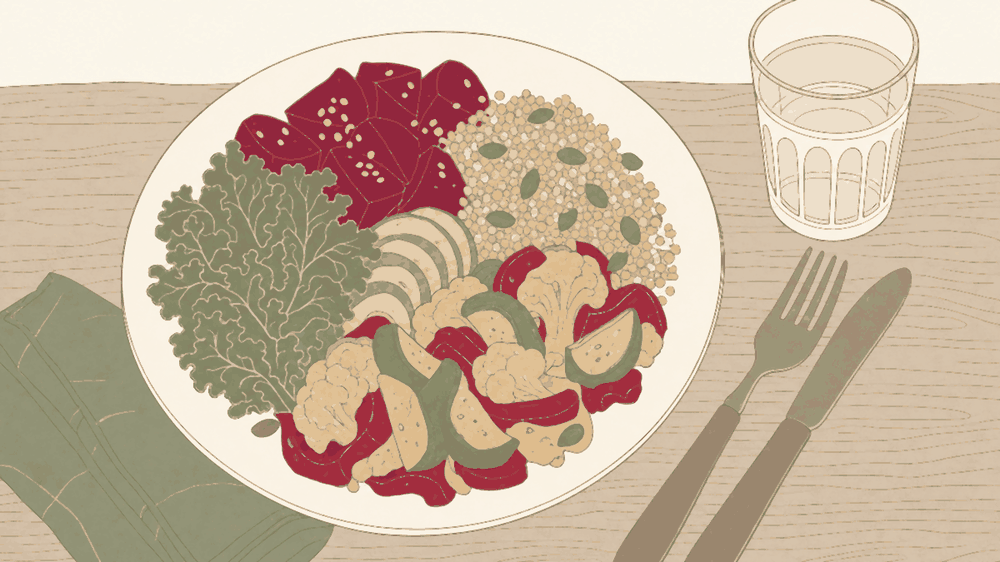
- Sit down and look at the plate for a few seconds before you start.
- Eat the first two mouthfuls slowly, noticing taste and texture.
- Partway through the meal, put the cutlery down and read the questions in the box again.
- Carry on as you prefer, with the information you have gathered.
- At the end, note one thing only: what made this meal satisfying, or what was missing.
After a few weeks many people say they recognise earlier the moment when the wish to continue fades. Others discover that their least satisfying meals were the ones eaten standing up. These are not spectacular achievements, but they change the relationship with the table more than any rule does.
If you would like to work on this with some support, in my mindful eating programmes we always start from observing and from your actual schedule. I trained as a Mindful Eating Trainer® and Intuitive Eating Trainer®, registered trademarks of UpMind Sagl.
Frequently asked questions
Fullness is mostly about the physical side: the food is enough and the drive to eat decreases. Satisfaction is about taste, pleasure, texture and the setting of the meal. You can be full without being satisfied, and that combination often leads to looking for something shortly afterwards.
It helps to put the cutlery down partway through the meal and notice three things: the taste right now, whether hunger has changed, and whether there is still a wish to continue. There is no exact point that holds for every meal, and no number is needed.
This is known as sensory specific satiety, described by Rolls in 1986: the pleasure linked to one food declines while we eat it, while it stays intact for other foods. It is normal and it does not mean the dish was wrong.
A less hurried pace leaves more time for signals to arrive, so it usually helps. That said, eating slowly is not a rule to follow at every meal: it is a useful condition when you want to observe what is happening.
Sources
- Benelam, Satiation, satiety and their effects on eating behaviour, 2009
- Rolls, Sensory specific satiety, Nutrition Reviews, 1986
- Amin and Mercer, Hunger and Satiety Mechanisms, Current Obesity Reports, 2016
- Tribole and Resch, 10 Principles of Intuitive Eating
- Harvard T.H. Chan School of Public Health, The Nutrition Source, Mindful Eating