


Two names that almost always appear together
It comes up often in conversation: someone tells me they have read something about eating with awareness and asks whether mindful eating and intuitive eating mean the same thing. The overlap is understandable, because in the scientific literature the two terms are sometimes used interchangeably, as a literature review published in 2017 in Nutrition Research Reviews points out.
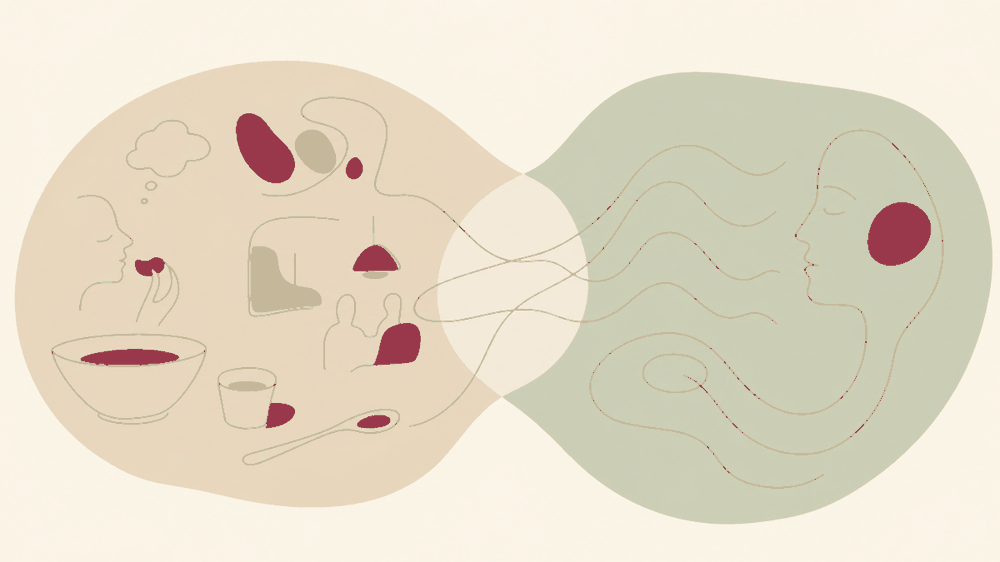
I prefer to keep them apart, not out of a taste for labels, but because they point to two different kinds of attention. One is mainly about the quality of attention during a meal. The other is about trust in internal signals and about our relationship with the rules we carry around. In practice they meet constantly.
What mindful eating means
Mindful eating brings the attitude of mindfulness to eating: observing present experience without judging it. In concrete terms that means noticing taste, texture, temperature, the pace you are eating at, the thoughts that show up and the mood you sit down with. Context is part of the observation too: eating standing up, in front of a screen or in company are not the same experience.
The 2017 review I mentioned describes mindful eating as present moment awareness while eating, attention to how food affects the senses and to the physical and emotional sensations that accompany a meal, and notes that no universal definition exists. That caveat is useful: this is not a protocol, it is a direction of attention.
What intuitive eating means
Intuitive eating as a structured approach is associated with Evelyn Tribole and Elyse Resch, two American dietitians who published its first formulation in 1995 and who now set out its ten principles on the official site of the approach. Its centre of gravity is the shift from external rules towards trust in the body's signals: honouring hunger, recognising fullness, making room for satisfaction, loosening the weight of rigid prescriptions about what may be eaten and when.
In research the approach is measured with dedicated instruments. In 2013 Tylka and Kroon Van Diest refined the Intuitive Eating Scale into a 23 item version, which looks among other things at the tendency to follow hunger and fullness cues when deciding when, what and how much to eat. Being measurable is what allowed the approach to be studied systematically.
These are not questions to answer once and for all. They are points of observation, usable during any ordinary meal.
Where the two approaches are alike
Both begin with a change of direction: from outside to inside. Instead of asking what a rule prescribes, you observe what is happening while you eat and how your body responds. Both place the person's experience at the centre, without sorting foods into good and bad and without asking for any performance.
- Attention to internal signals rather than to rigid external instructions.
- No sorting of foods into moral categories.
- Interest in pleasure and satisfaction, not only in quantity.
- A gaze that observes and describes, instead of correcting straight away.
Where they differ
The most useful difference concerns scope. Mindful eating works mainly on the moment of the meal and on the quality of attention: slowing down, recognising taste, noticing passing thoughts. Intuitive eating has a wider reach: it also covers our relationship with learned rules, the role of emotions and the trust built over time towards our own signals.
Put another way: mindful eating is a way of being inside the experience, while intuitive eating is a broader frame that contains that experience and adds our relationship with our own mental habits. That is why I never present them as competitors. The people I work with usually draw on both, in varying proportions.
The role of hunger, fullness and satisfaction
The clearest meeting point between the two approaches is the observation of hunger, fullness and satisfaction. These are three different signals: hunger opens the meal, fullness reports that the body has received what it needed, satisfaction has to do with taste and pleasure. They can appear at different moments and hardly ever line up perfectly. I go into this at greater length in hunger, fullness and satisfaction.
Telling them apart helps make sense of very common situations: finishing a meal full but unsatisfied and still looking for something, or noticing that what you were after was a pause rather than food. None of this needs to be sorted out during the meal itself. It is usually enough to notice it, and to come back to it later with a little curiosity. Here too the material is for observing, without rushing to conclusions. If the line between bodily hunger and hunger tied to emotions interests you, I explored it in physical hunger and emotional hunger.
What research says about these approaches
The literature has grown considerably over the past twenty years, with uneven quality. The structured review published in 2017 in Nutrition Research Reviews gathers studies on mindfulness, mindful eating and intuitive eating and reports promising findings on eating behaviour along with clear methodological limits: small samples, definitions that vary, protocols that are hard to compare.
The existence of measurement tools such as the Intuitive Eating Scale has helped as well, since it allows the approach to be studied more precisely rather than only described. The field remains open: the available research justifies both interest and caution, and it does not support any promise of results.
How I use these two approaches in my work
I earned my Mindful Eating Trainer® and Intuitive Eating Trainer® certifications at UpMind Sagl, which holds both registered trademarks. In the paths I offer I do not apply one identical protocol to everyone: we start from how you eat now, from what you notice and from what feels difficult, and from there we choose where attention is worth placing.
Sometimes the work starts from the meal itself: slowing down, recognising flavours, observing the setting. Sometimes it starts from the rules a person has built over the years, which cover the body's signals. If you want to see how an accompaniment unfolds, the details are on the paths page.
This article is informative in purpose and does not replace a clinical assessment. Where an eating disorder is present, it is necessary to turn to qualified health professionals.
Frequently asked questions
Mindful eating is mainly about attention to the experience of eating: taste, sensations, thoughts, setting. Intuitive eating is a broader frame, centred on trust in internal signals and on a less rigid relationship with learned rules. The two overlap a good deal.
The approach is associated with Evelyn Tribole and Elyse Resch, two American dietitians who published its first formulation in 1995 and who set out the ten principles on the official site of the approach.
Not exactly. It grows out of the mindfulness attitude, meaning observing the present moment without judging it, but it is applied to an everyday activity: eating. No formal meditation practice is required.
No, they are not competing alternatives. In practice they are often used together, in proportions that vary with the person and with whatever comes up along the way.
Sources
- The ten principles of intuitive eating, official site of the approach
- Structured review on mindfulness, mindful eating and intuitive eating, Nutrition Research Reviews, 2017
- Tylka and Kroon Van Diest, 2013, Intuitive Eating Scale 2
- Harvard T.H. Chan School of Public Health, mindful eating overview
- UpMind, Mindful Eating Trainer® and Intuitive Eating Trainer® training