
A question I hear very often
It is nearly always asked quietly, as if it were the confession of a flaw. The sentence comes out the same way each time: why do I eat when I am stressed, even when I am not hungry. Then comes the comment about oneself, also always the same: I have no willpower, I cannot control myself. I prefer to start somewhere else, because that gesture does have a logic, and understanding it takes you further than judging it.
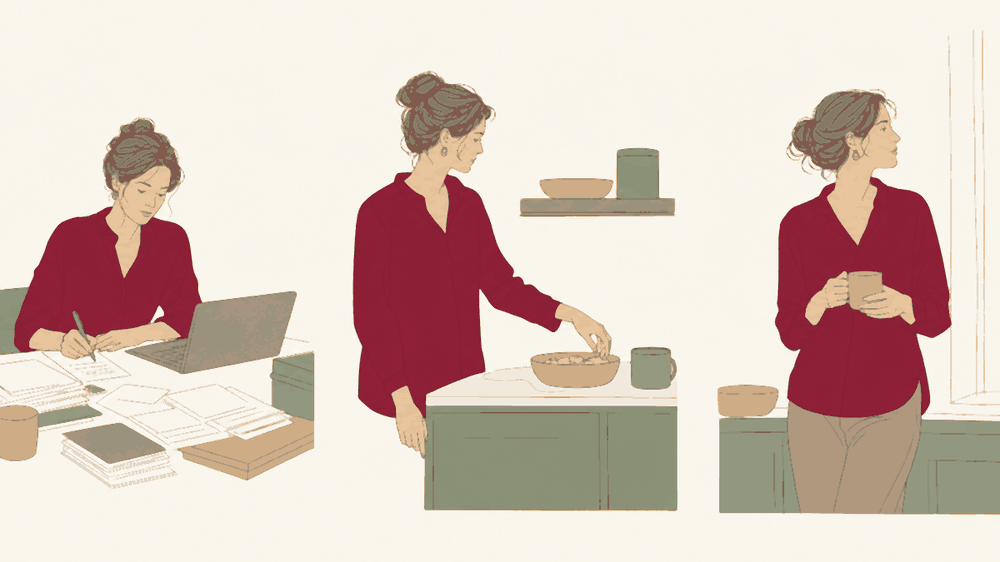
In my work that moment is not a mistake to erase. It is information. When someone eats regularly in the same part of the day, that part of the day is usually asking for something specific: a pause, a change of pace, a small pleasure after hours of responding to other people. Food, right there, is the fastest available answer.
What happens when the day is intense
Stress does not affect everyone in the same way. The review by Yau and Potenza, published in 2013, describes a varied picture: in some people appetite rises, in others it drops, and prolonged stress often comes with a shift in preference towards highly palatable foods, rich in sugar or fat. These are research observations, not individual rules; how each person responds stays personal.
Then there is the practical shape of the day, which sometimes matters more than physiology. Meals rushed in front of a screen, very long gaps between eating occasions, short nights, no moment of transition between work and evening. Reaching seven in the evening with all of that behind you makes the wish for something sweet fairly logical.
The automatic gesture starts before the thought
Many everyday behaviours run without a conscious decision: they are links between a context and an action, repeated often enough to become smooth. The study by Lally and colleagues in 2010 followed almost a hundred people over twelve weeks and measured how a daily action became automatic. The time needed varied enormously between people, and missing a single opportunity did not derail the process. One thing follows from that: automatic behaviour is built by repetition in a stable context, not by weakness of character.
This is why the gesture is so precise. It does not happen randomly through the day, it happens at a recognisable moment, almost always the same one. Spotting that context is already half the work.
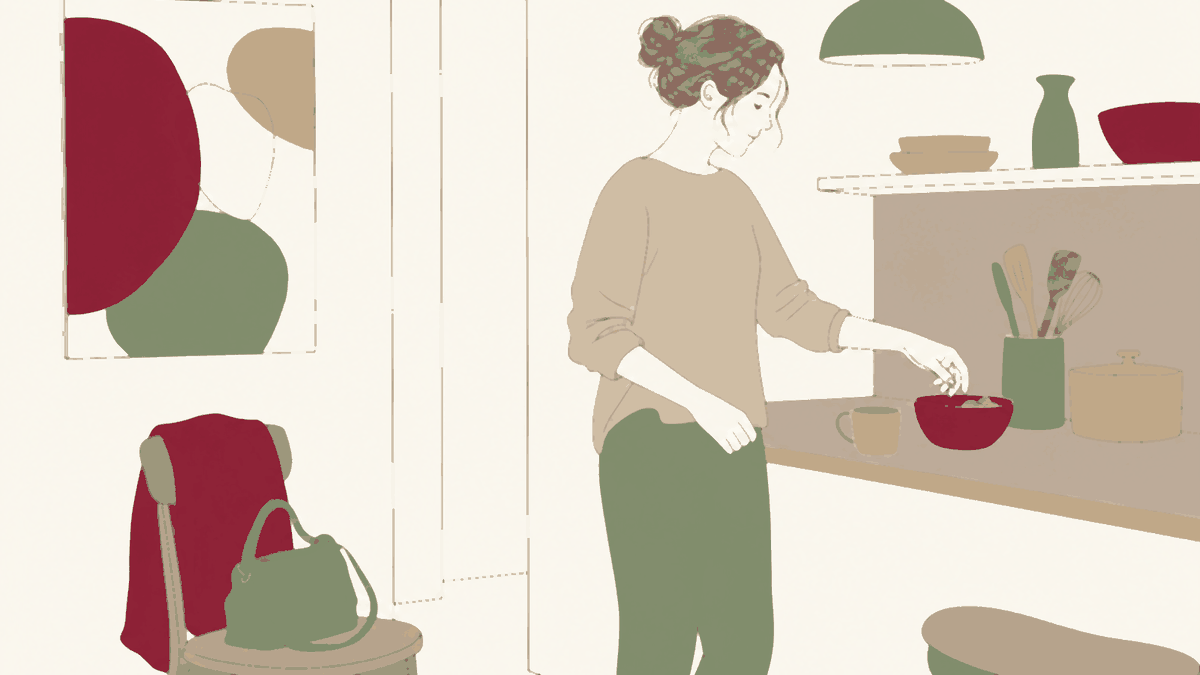
- Coming home, with your bag still in your hand.
- The end of a long meeting or a difficult phone call.
- The evening in front of a screen, when the day had no closing point.
- The office drawer, opened in the same quarter of an hour every day.
- The instant you stop working with nothing in between.
Why deciding to stop is not enough
The first route most people try is a rule: from tomorrow I will not do it again. It holds for a few days, then the most tiring evening of the week arrives anyway and the rule collapses. A second problem then appears that was not there at the start: the sense of failure. Tension rises and the gesture, instead of fading, carries even more weight.
The order seems different to me. First you look, then you change something if you want to. Looking asks for no discipline, only a few seconds of attention in a moment that usually receives none. It is small, repeated work, far less costly than a ban.
These lines are not there to decide whether you may eat or not. They are there to see a little more clearly what is going on, nothing more.
Recognising comes before changing
The question at the centre of the box above can be kept in your pocket and used when needed, standing up, fridge door still open. It expects no correct answer. Sometimes the answer is that hunger really is there, because lunch was at half past eleven. Sometimes it is that ten minutes of quiet were needed, and eating was the only known way to take them.
Before asking how to change that gesture, I ask what it is asking for.
After a few weeks of this kind of noticing, people often tell me that the gesture has not disappeared, but the way they live it has changed: less automatic, less followed by self reproach. If you want the detail on the difference between body signals and other pushes to eat, I write about it in physical hunger and emotional hunger.
A tense body notices less
Another element keeps coming back. When tension stays high for weeks, internal signals become harder to tell apart: hunger arrives suddenly or not at all, fullness is noticed late. Cherpak, in a 2019 review, discusses exactly this link between stress, digestion and attention during a meal, underlining how much the state of the nervous system shapes the experience of eating.
That is why I often do not start with food. I start with a learnable, repeatable space of relaxation such as Autogenic Training, which I describe in what Autogenic Training is. A body slightly less on alert makes noticing signals much easier.
What the research says, in measured terms
A cross sectional survey carried out in Germany by Kaiser and colleagues in 2022, with 1222 adults, found that roughly four in ten recognised themselves in eating more in response to stress, with some foods named more often, among them chocolate, confectionery, coffee and biscuits. These are self reported answers collected online: a picture of how people describe themselves, not evidence of cause and effect.
On mindfulness based approaches, the available syntheses, for example the review by O'Reilly and colleagues in 2014, report encouraging signals for behaviours such as eating in response to emotions, with very mixed studies and often small samples. I prefer to say it that way, without inflating the conclusions: interesting indications that deserve better research.
How I work on this in my sessions
I am a nutrition coach, Mindful Eating Trainer® and Intuitive Eating Trainer®, registered trademarks of UpMind Sagl, and an Autogenic Training practitioner. We start from real situations in your week rather than general schemes: which moment repeats, what comes before it, what makes it so automatic. From there we look at what can be observed and what is worth trying differently, if you wish.
If you want to see how this kind of support is structured, the formats are described on the programmes page. You do not need to arrive with a defined goal: the first step is often simply to stop treating that gesture as a fault.
This article is for information only and does not replace a professional assessment. If your relationship with food causes distress or takes up much of your thinking, please speak with a doctor or a psychotherapist.
Frequently asked questions
Because in that moment eating is the fastest available answer to a need that is often something else: a pause, a change of pace, an immediate pleasure. Prolonged stress also changes appetite and food preferences.
They cannot always be separated cleanly, and that is not essential. A simple question such as what is happening right now helps you see whether there is hunger, a wish for something pleasant, a need to stop, or all of these together.
It is a very common behaviour and in itself it does not indicate a disorder. Asking for help becomes useful when it takes up a lot of mental space, causes distress, or remains the only available strategy in hard moments.
Rarely with a ban, which raises tension, and more often with repeated noticing of the moment it happens. Identifying the context, the time and what comes just before makes it possible, later on, to add other options.
Sources
- Yau and Potenza, 2013, stress and eating behaviours
- Kaiser and colleagues, 2022, survey of 1222 adults, BMC Public Health
- Lally and colleagues, 2010, how habits are formed
- Cherpak, 2019, stress, digestion and attention while eating
- O'Reilly and colleagues, 2014, review on mindfulness and eating behaviours