

Two words that hold the whole method
The name sounds technical, yet it describes exactly how the method works. Training means learning and gradual practice: you start from one simple element, repeat it for days, then add another. Autogenic means that what happens is progressively generated by the person themselves: no external voice needs to guide you, no device needs to record anything.
That is the difference I notice most often compared with other relaxation tools. Here you do not receive relaxation from outside, you learn a practice. Guidance helps at the beginning, then the practice is yours: on a train, in a waiting room, in the evening before sleep, with no headphones and no subscription.
Where it comes from: Johannes Heinrich Schultz
The method was developed by the German physician Johannes Heinrich Schultz, who presented it to a medical society in Berlin in 1926 and published it in 1932. Schultz had observed that many people, after experiences of deep relaxation, reported two recurring sensations: heavy limbs and diffuse warmth. His question was simple: if the body produces those sensations by itself, can a person learn to call them up without depending on a practitioner.
From that insight comes the aspect I still find most interesting. A century ago relaxation was something done to you. Schultz proposed an independent practice that could be taught and repeated at home. The name of the method holds both ideas: you learn it and you generate it yourself.
How a practice unfolds
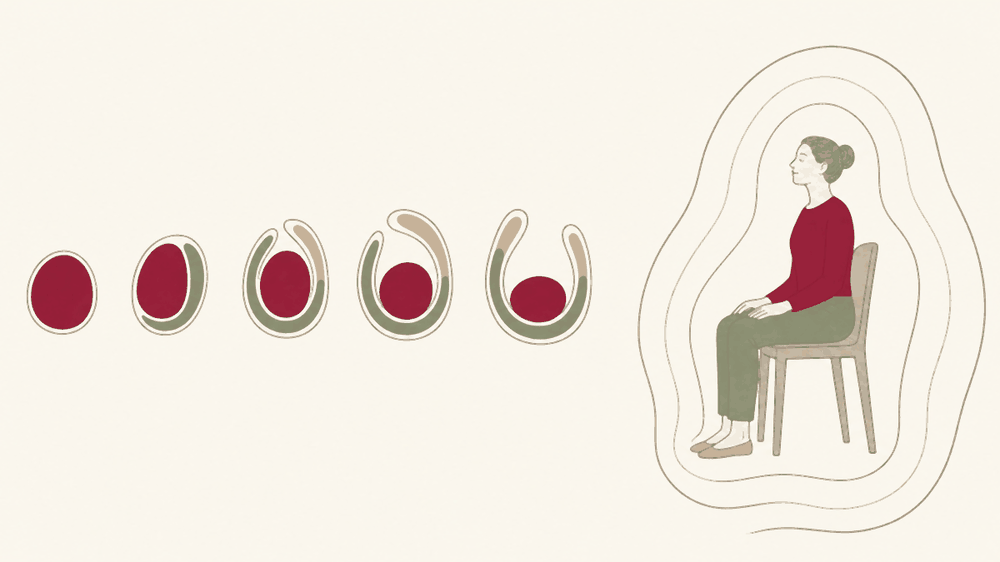
You find a stable position, seated with your back supported or lying down. You close your eyes and bring attention to a short formula, for instance the heaviness of one arm. You do not push and you do not check whether it is working: you keep attention on the phrase and on the sensation for a few minutes. You always finish with a return: moving your fingers, bending your arms, opening your eyes.
The classic sequence has six elements, learned one at a time and added up over the weeks, as public health information materials also describe.
- Heaviness in the limbs.
- Warmth in the limbs.
- A calm, regular heartbeat.
- Breathing, left to happen without steering it.
- Warmth in the area below the breastbone.
- Coolness on the forehead.
Attitude matters more than technique
The most misunderstood point is not the formulas but how people approach them. Many begin as if facing a performance: I must feel the warmth, I must succeed, I must relax now. With that intention the body tightens and nothing happens. The literature describes a different attitude: attention resting on the formula and indifference towards the result.
Relaxation does not arrive by pushing. It arrives when you stop checking whether it is arriving.
The comparison with sleep holds: nobody falls asleep by deciding to fall asleep, you create the conditions and the rest follows. In the first weeks this is where guidance helps more than any written explanation, because the recurring question is always the same: am I doing this properly.
There is nothing to achieve and nothing to measure. These are prompts for bringing attention to the body as it is today.
The reason is yours to choose
In my sessions I do not decide why you should practise. At the start we define together what you would like from the practice, and the motivation comes from you: a wish to slow down, to give yourself moments of relaxation, to pay more attention to the body, or simply to learn a practice you can use in daily life. Different reasons lead to different ways of fitting Autogenic Training into the week.
That first step looks like a formality and yet it changes a great deal. When the reason is clear, the practice finds a realistic place in the day: a few minutes after coming home, a pause in the middle of the afternoon, ten minutes before the evening meal. When the reason stays vague, the practice becomes the first thing dropped in a busy week, and the blame then goes to a lack of time.
Some people come because of muscular tension or broken sleep. Others come to slow down before meals, when eating quickly has become automatic: I write about that pattern in why we eat when we are stressed. The available formats are described on the programmes page.
What the research says, without exaggeration
The most cited synthesis is still the meta analysis by Stetter and Kupper in 2002: the authors identified 73 controlled studies and included 60, of which 35 were randomised. Comparing before and after treatment, effects range from medium to large; against control groups they remain medium and hold over time.
An honest qualification is needed, and it is explicit in the same work: comparison with other psychological treatments shows no advantage for Autogenic Training. It is one valid tool among many, not a superior one. Presenting it as the best possible choice goes beyond the available data.
The systematic review with meta analysis by Seo and Kim in 2019 selected 21 studies out of 950 identified and included 11 in the quantitative synthesis: they report reduced anxiety and depressive symptoms and an increase in heart rate variability in its high frequency component, an indicator associated with parasympathetic nervous system activity. A 2023 review by Breznoscakova and colleagues reaches comparable conclusions and urges caution about the quality of part of the evidence.
How long it takes, and when to be careful
A single formula usually needs one or two weeks of short daily practice; for the full sequence the timescale varies widely from person to person. Little and often works better than one long weekly session. In the first weeks what matters is not duration but regularity: a few minutes on most days count for more than an occasional half hour. On moving from guided practice to independence I have written a separate article: how Autogenic Training is learned.
One last point, and an important one. The literature notes that the method is not indicated in acute psychotic states, and that with an ongoing medical condition a conversation with your doctor comes before anything else. That is not a formality, it is how the practice stays safe.
This article is for information only. Autogenic Training is a way of learning relaxation and does not replace a diagnosis or a therapy.
Frequently asked questions
It is a relaxation practice in which you bring attention to short formulas, such as heaviness or warmth in the arms, and let the body respond. It was presented by Johannes Heinrich Schultz in 1926 and published in 1932.
It means that the experience is progressively generated by the person themselves. No external voice runs the practice: after the initial learning phase, the practice belongs to whoever uses it.
A single formula usually takes one or two weeks of short daily practice. For the full sequence the timescale varies a great deal and depends on regularity rather than on any particular aptitude.
Available syntheses report favourable effects on anxiety and depressive symptoms, with no advantage over other psychological treatments. It is not a cure: if anxiety interferes with daily life, a doctor or a psychotherapist remains the right reference.