

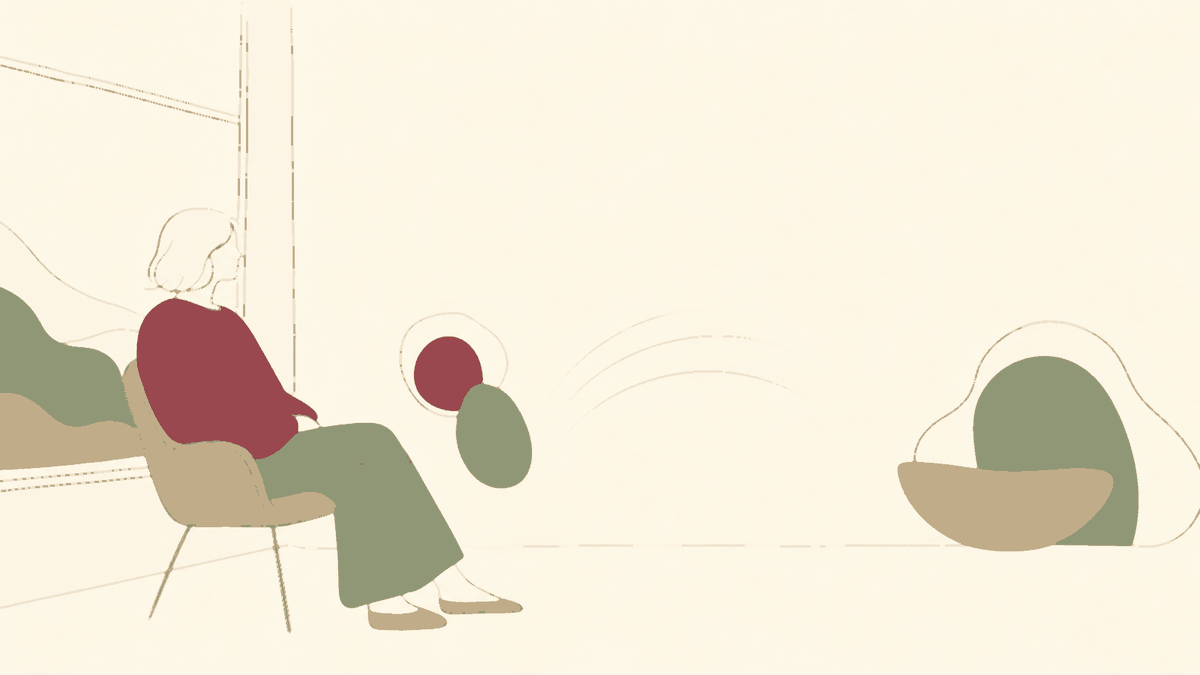
Why so many people say they have lost control
Days fill up with things you did not choose: notifications, requests, deadlines, journeys between Chiasso and Lugano, small decisions taken at speed. By the end of the week many people describe the same impression: life went past and they were not there for it. This is not laziness or weak willpower. It is what happens when attention is pulled in every direction at once.
In that state the sense of agency weakens. Research uses this term for the perception of being the author of your own actions and of their effects. When that perception thins out, our days seem to happen to us rather than being lived by us.
What mindfulness actually is, with no misunderstandings
Mindfulness is attention training. You bring attention to what is happening in this moment, in the body, in the breath, in sounds, in thoughts, and you notice when it wanders off. Then you bring it back. That movement, repeated many times, is the practice.
It is not a technique for emptying your head, it does not require sitting cross legged and it does not ask you to feel serene. Quite the opposite: in practice you also notice hurry, irritation and tiredness. The difference lies in how you look at them, not in making them disappear.
The main misunderstanding: mindfulness does not increase control over events
Many people start practising in the hope of managing reality better: the workload, the traffic, other people's temperament, the results. The practice promises none of that, and it could not deliver it anyway. The train is still late after ten minutes of attentive breathing.
If you are looking for control over events, mindfulness looks useless. If you are looking for a different way of responding to events, everything shifts. The distinction is small in words and large in everyday life.
The turning point: decentring
The mechanism that makes the practice useful is called decentring. It means observing thoughts as passing mental events, not as facts to be verified and not as orders to be obeyed. The thought is worth neither more nor less: it is seen for what it is.
The literature describes three components. The first is metacognitive awareness: you know that you are thinking while you think. The second is disidentification from inner experience: the thought is present, yet it does not define you. The third is reduced reactivity to the content of thoughts: a difficult thought no longer drags a behaviour along with it automatically.
Between what happens and what we do there is a space. Practice does not create it, it makes it visible.
Why this gives back the feeling of having a choice again
Here is a concrete example. A curt message arrives from work. On automatic the sequence is almost instant: irritation, tension, a reply typed in a rush, half an hour of looping thoughts. With some practice the same sequence opens up: you notice the irritation, you feel the clenched jaw, you recognise the thought, and inside that millimetre of space you decide whether to answer now or after lunch.
No event has changed. Your position towards the event has changed: you are no longer inside the reaction, you are next to it. Repeated many times a day, this shift rebuilds the perception that you are the one deciding, which is exactly what people mean when they talk about taking back control of their life.
Living fully: the difference between autopilot and presence
Autopilot is useful: it lets you drive, walk and cook without thinking. It becomes a problem when it also takes over the parts of life you would like to feel. Dinner with someone you love, spent thinking about your inbox, is a dinner that has gone missing.
Living fully, in this sense, does not mean doing more things. It means being present in the things you already do. The paradox is that this presence is trained in very ordinary situations: washing dishes and feeling the water, walking and feeling your feet, drinking a coffee and actually looking at it.
- Autopilot: you act, but you do not notice what you are doing.
- Presence: you do the same thing and you notice its details.
- Autopilot: you react with your usual response.
- Presence: you notice the impulse and choose whether to follow it.
What research says about mindfulness, without overstating it
The Mindfulness-Based Stress Reduction programme began in 1979 with Jon Kabat-Zinn at the University of Massachusetts medical centre, first called the stress reduction and relaxation programme. The standard format runs for eight weeks, with weekly meetings of about two and a half hours plus one full day of intensive practice.
An individual participant data meta analysis published in Nature Mental Health in 2023 indicates that mindfulness based programmes reduce psychological distress with a small to moderate effect, maintained for at least six months. A meta analysis of 17 randomised trials and 1641 participants reports a reduction in perceived stress. Dispositional mindfulness, meaning the spontaneous tendency to be present, is inversely associated with perceived stress.
The picture is encouraging and deserves a measured reading: real effects, modest sizes, wide variation between individuals. Mindfulness does not fix a difficult life situation and it is not a clinical treatment. It is a training that, with consistency, changes the way you move through difficulty.
Three short practices to try this week
The three suggestions below are attention exercises. They are not treatments and their aim is not to make you feel good: they are there to help you notice where you are.
- A breathing space of three minutes: one minute to notice what is here in thoughts, emotions and body; one minute on the breath; one minute widening attention to the whole body.
- A short exploration of the body: ten minutes lying down, moving attention from the feet to the head, without trying to change anything.
- One meal eaten with full attention: screens off, the first three mouthfuls tasted slowly, a pause halfway through to ask what you feel in your stomach.
If a more concrete route into physical relaxation appeals to you, autogenic training is a good starting point and it sits well alongside these practices.
Mindfulness and your relationship with food
Food is one of the areas where autopilot shows up most clearly. We eat standing up, in front of a screen, while thinking about something else; then guilt arrives, which is simply another automatic habit. As a Mindful Eating Trainer® and Intuitive Eating Trainer®, both registered trademarks of UpMind Sagl, I work on that one step: notice first, then choose.
In my work we talk about neither calories nor weight. We look at moments, sensations, body signals and habits that keep repeating. You can read my approach to see where we start, or go straight to the programs. For a specific question, write to me through the contact page.
This article is informative in purpose. Mindfulness is an educational path and it does not replace a diagnosis or a therapy. If you are living with significant anxiety, a mood disorder, an eating disorder or another clinical condition, please speak with a health professional before starting an intensive practice.
Frequently asked questions
It is deliberate attention to what is happening now, held with openness and without judgement. You train it by noticing where the mind goes and bringing it back, many times, to an anchor such as the breath.
It does not increase control over events. It makes the space between stimulus and response visible, and that gives back the sense of having a choice again.
Five to ten minutes a day, done regularly, is a realistic start. Consistency matters more than the length of any single session.
It is the protocol that began in 1979 with Jon Kabat-Zinn at the University of Massachusetts medical centre. It runs for eight weeks, with weekly meetings of about two and a half hours and one full day of practice.
Available syntheses report reductions in perceived stress and psychological distress, with small to moderate effects. It is not a clinical treatment and results vary widely between people.
No. Thoughts keep arriving. The exercise is to notice them and not to follow them automatically.
Meditation covers a broad family of practices. Mindfulness is one of them, centred on attention to what is happening in the present moment.
Mindful eating applies the same principles to the meal itself: attention to flavours, to hunger and fullness signals, and to automatic habits.
Sources
- Mindfulness-Based Stress Reduction, overview on Wikipedia
- Jon Kabat-Zinn, reflections on the origins of the programme
- Individual participant data meta analysis, Nature Mental Health 2023
- Mindfulness based interventions and perceived stress
- Dispositional mindfulness and perceived stress
- A metacognitive process model of decentring
- Oxford Mindfulness, responding instead of reacting
- Sense of agency in meditation practitioners